

In This Article
Global regulators imposed $4.6 billion in financial penalties during 2024, with North America accounting for 95% of the total (Fenergo, January 2025). More than $3 billion of that came from anti-money laundering non-compliance. But the enforcement actions that tell you the most about your own risk are the ones that started with something much smaller than intentional fraud.
The OCC issued a cease-and-desist order against USAA Federal Savings Bank for what it called "significant failures in risk governance, compliance, and information technology management." Not fraud. Not theft. System failures. The FDIC pursued Cross River Bank for fair lending compliance failures tied to technology gaps in its banking-as-a-service model. Bank of America paid $12 million because its loan origination system let officers skip required HMDA demographic fields. Fay Servicing owed $5 million in penalties and was required to invest $2 million in technology upgrades to fix the systems that caused violations in the first place.
Most regulatory violations at banks, credit unions, and mortgage companies do not start with someone deciding to break the rules. They start with systems that make compliance harder than it should be. When your interfaces force manual workarounds, bury required fields, or allow inconsistent data entry, violations become a matter of time regardless of which regulator comes knocking.
HMDA violations were the most frequently cited violation by Federal Reserve examiners for the third consecutive year in 2024. The primary root causes were manual input errors and weaknesses in secondary review processes, not intentional data manipulation.
Federal Reserve Consumer Compliance Examination Data, 2024The Multi-Regulator Enforcement Landscape in 2025-2026
Financial institutions answer to multiple regulators simultaneously. A community bank might face the OCC, FDIC, FinCEN, and state banking department all examining different aspects of the same operation. A credit union answers to the NCUA and state regulators. A mortgage company deals with the CFPB, state licensing authorities, and investor compliance requirements from Fannie Mae and Freddie Mac.
The enforcement posture has shifted but not softened. The CFPB reduced examinations by 50% starting in early 2025 and shifted toward pursuing cases with clear evidence of intentional harm. The OCC maintained active enforcement in 2024. The FDIC prioritized banking-as-a-service risks and IT management deficiencies. NCUA adopted a "no regulation by enforcement" posture but maintained supervisory standards that carry the same practical consequences.
What every regulator shares: they expect your technology to enforce compliance rules automatically. Manual processes that depend on human memory, judgment, or discipline under production pressure are not compliance programs. They are compliance hopes.
Five Violation Categories That Start with Bad Systems
These violation patterns appear across banks, credit unions, and mortgage companies. The common thread is not bad intent. It is system design that makes the wrong thing easier than the right thing.
| Violation Category | Regulators | System Root Cause | Real-World Example |
|---|---|---|---|
| Data accuracy failures (HMDA, CRA, call reports) | OCC, FDIC, Fed, CFPB | Optional fields that should be mandatory; no validation at point of entry | Bank of America: $12M for HMDA data gaps |
| BSA/AML monitoring gaps | FinCEN, OCC, FDIC, NCUA | Disconnected transaction systems; manual SAR filing processes | Multiple FDIC consent orders for BSA monitoring gaps in BaaS platforms |
| Fair lending pattern violations | CFPB, DOJ, OCC, FDIC | Siloed pricing/underwriting/marketing systems without centralized monitoring | Trident Mortgage: $24.4M redlining settlement |
| IT governance and risk management | OCC, FDIC, FFIEC | Inadequate system controls, missing audit trails, poor change management | USAA: OCC cease-and-desist for IT management failures |
| Disclosure timing violations (TILA, TRID, UDAAP) | CFPB, state regulators | LOS pipeline stages disconnected from disclosure generation workflow | Fay Servicing: $7M penalty + $2M mandatory tech investment |
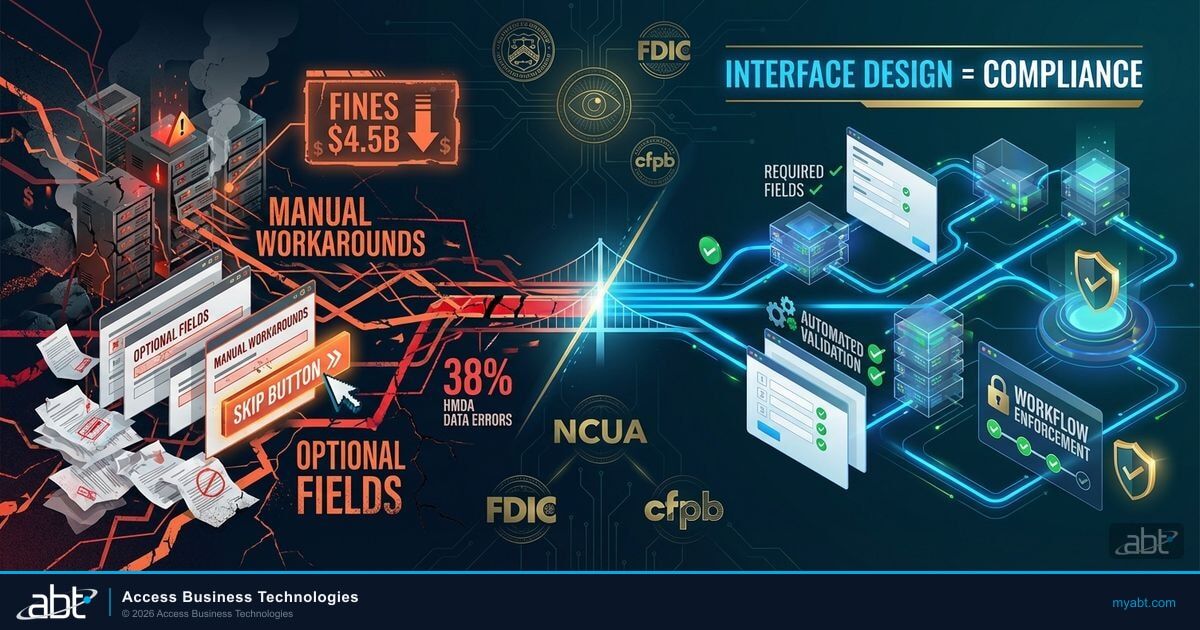
Data accuracy failures are the most common and preventable. Bank of America's $12 million HMDA penalty came from loan officers skipping demographic questions because the system allowed it. When your LOS permits submission of applications with blank required fields, you are building a violation machine. Required fields should be genuinely required, with the system blocking progression until completion.
BSA/AML monitoring gaps grow whenever transaction data lives in disconnected systems. When your core banking platform, wire transfer system, and ACH processing run independently without automated suspicious activity detection across all channels, patterns that should trigger SARs go unnoticed. Multiple FDIC consent orders against banking-as-a-service platforms have demonstrated how technology-enabled compliance gaps create enforcement targets.
Fair lending patterns develop invisibly when pricing engines, underwriting workflows, and marketing systems operate independently. Subtle differences in loan pricing, approval rates, or marketing distribution across demographics can create the appearance of discrimination without anyone intending it. Centralized monitoring that connects these systems is the only way to detect patterns before regulators do.
IT governance failures have become a standalone enforcement category. The OCC's action against USAA cited system controls, reporting, and technology management specifically. FFIEC examination procedures now evaluate whether your institution treats IT governance as a board-level responsibility, not just a department function.
Disclosure timing violations happen when your disclosure generation system does not integrate with your pipeline stages. A loan that moves from application to processing while a disclosure sits in someone's outbox creates a TILA violation that automated workflow integration would prevent entirely.
A loan officer is closing three applications before lunch. The system presents a demographic information screen with optional fields. Under time pressure, the officer skips them on all three. Multiply that decision across 200 loan officers over three years.
Systematic HMDA data gaps that cost Bank of America $12 million. The system design created the violation by making the wrong choice the easy choice.
How Interface Design Drives or Destroys Compliance
Every screen, dropdown, required field, and workflow step in your financial institution's systems either supports compliance or undermines it. There is no neutral position.
When the interface makes the compliant path the easiest path, compliance happens naturally. When compliance requires extra clicks, separate screens, or manual cross-referencing between systems, shortcuts become inevitable. Not because your team is careless. Because humans choose the path of least resistance under production pressure, and no amount of training overcomes bad system design.
Data validation at point of entry. Your core system and LOS interfaces should validate information in real time. If a Social Security number format is wrong, flag it immediately. If an income figure seems inconsistent with employment data, prompt the user to verify before allowing the record to save. Catching errors at entry costs seconds. Catching them during an OCC examination costs millions.
Workflow enforcement versus workflow guidance. There is a meaningful difference between a system that suggests the next step and one that requires it. Suggestion-based workflows let busy staff skip steps under deadline pressure. Enforcement-based workflows make it physically impossible to advance a loan, account opening, or transaction without completing required compliance checks.
Audit trail automation. Every action in your systems should create an auditable record without anyone thinking about it. When the OCC, FDIC, or NCUA requests documentation of who did what and when, your answer should come from automated logs, not from asking employees to recall actions from six months ago.
Cross-system data consistency. When borrower information in your LOS differs from the same data in your core system, and both differ from what your compliance reporting tool shows, every discrepancy becomes a potential finding. Interfaces that synchronize data automatically between systems eliminate the inconsistencies that trigger examination flags.

Building Compliance Into Your Technology Workflows
Start with your highest-risk processes
Loan origination, account opening, wire transfers, and BSA/AML monitoring touchpoints deserve the most rigorous interface controls. Map your most recent examination findings to specific system workflows and prioritize those connections first. If your last FDIC exam flagged BSA monitoring, that system gets upgraded before anything else.
Implement real-time compliance dashboards
A centralized dashboard should show how many loans have pending disclosures, which account applications have incomplete fields, and where in the pipeline timing requirements approach deadlines. When your compliance officer sees the entire operation from one screen, problems surface before they become violations. Microsoft 365 and Power BI provide the foundation for compliance dashboards that pull data from across your technology stack.
Automate regulatory change integration
The CFPB updated TILA and Consumer Leasing Act (Regulation M) thresholds for 2026. The OCC revised its heightened standards. NCUA updated its cybersecurity examination procedures. Your compliance management approach should include a documented process for updating system workflows when new rules take effect. The gap between rule change and system update is where violations occur.
Connect your marketing and compliance systems
UDAAP and fair lending violation patterns both start with marketing activities that compliance teams cannot monitor in real time. When your CRM, email platform, and content management system share data with compliance monitoring tools, promotional materials get reviewed before reaching clients rather than after a regulator flags them.
Standardize through automation
Human variability is the enemy of consistent compliance. When every loan officer, teller, or account manager follows a slightly different process, compliance becomes unpredictable. Automated workflows that enforce consistent steps across every transaction produce consistent compliance outcomes. This is not about removing human judgment. It is about ensuring judgment operates within guardrails that prevent violations.
The institutions that spend the least on examination response are the ones that spend the most on system design. When your technology enforces compliance rules at the point of action, examinations become documentation exercises rather than defensive operations.
Turning Compliance from Cost Center to Competitive Advantage
Financial institutions that build compliance into their system architecture gain advantages beyond avoiding fines.
Faster processing. When compliance checks run automatically within the workflow rather than as separate review steps, loans and account applications move through the pipeline faster. No waiting for manual reviews. No returned files for missing fields. No disclosure timing violations that require restart procedures.
Lower operational costs. Banks spend between 2.9% and 8.7% of non-interest expenses on compliance, with smaller institutions spending proportionally more (CSBS/St. Louis Fed, 2016). Automated compliance reduces the headcount required for manual oversight. When the CFPB ordered Fay Servicing to spend $2 million on technology upgrades as part of a 2024 consent order, it proved a simple point: institutions that invest in compliance automation proactively avoid paying for it under enforcement pressure.
The cheapest compliance investment is the one you make before the examination. The most expensive is the one the regulator forces you to make after.
Stronger client trust. Clients at banks, credit unions, and mortgage companies notice when their experience is smooth, transparent, and professional. Compliant processes treat clients fairly and provide complete information. This translates directly into satisfaction scores, online reviews, and referral business.
Easier examinations. When your systems produce complete audit trails, regulatory examinations become documentation exercises. The difference between producing automated compliance records and scrambling to reconstruct history determines whether an examination takes two weeks or six months.

ABT builds compliance-integrated technology environments for banks, credit unions, and mortgage companies. From interface design that enforces regulatory workflows to compliance monitoring configurations built on Microsoft 365 and Azure, our team combines deep regulatory knowledge with the technical depth to make compliance automatic rather than aspirational.
Your Compliance Technology Assessment
Find out where your systems create risk instead of preventing it:
- Interface audit: which required fields can currently be skipped
- Workflow gap analysis: where manual steps create compliance exposure
- Cross-system consistency check: where data differs between platforms
- Audit trail review: what actions lack automated documentation
Frequently Asked Questions
BSA/AML violations and fair lending violations produce the largest penalties across all institution types. AML-related fines accounted for more than $3.3 billion of the $4.6 billion in global bank fines during 2024 (Fenergo). Fair lending settlements can reach tens of millions, as the $24.4 million Trident Mortgage redlining case demonstrated. These cases share a common thread: systemic issues amplified by inadequate technology controls rather than individual bad actors making isolated decisions.
Comprehensive system audits should happen quarterly, with automated monitoring running continuously between audits. Any time a regulation changes or your core system receives a major update, trigger an immediate review of affected workflows. Real-time compliance dashboards reduce the need for periodic deep audits by surfacing issues as they develop rather than waiting for quarterly review cycles.
Automated systems complement compliance officers but do not replace them. Technology handles data validation, workflow enforcement, audit trail generation, and pattern monitoring. Compliance officers handle judgment calls, regulatory interpretation, examination response, and policy decisions requiring human expertise. The most effective programs combine automated systems that prevent routine errors with experienced professionals who address complex regulatory questions.
The CFPB reduced examinations by 50% and shifted toward cases with clear intentional harm. The OCC increased enforcement actions and elevated IT governance failures to standalone violation categories. The FDIC prioritized banking-as-a-service risks and technology management deficiencies. NCUA adopted a supervisory-first approach over punitive enforcement. Across all regulators, institutions with weak technology controls still generate the patterns and documentation gaps that create enforcement targets.
Audit which required fields in your core system and LOS can currently be left blank or bypassed. Making genuinely required fields mandatory at the system level prevents the most common HMDA, BSA, and disclosure documentation failures. This change costs almost nothing to implement but eliminates data gaps that trigger examination findings. After enforcing required fields, add automated workflow timing to prevent disclosure delivery violations.