

In This Article
What happens when Microsoft gives Copilot a coworker that runs multi-step work in the background, uses AI models from more than one company, and can take action across your entire Microsoft 365 environment? That's Copilot CoWork, and it reached worldwide general availability on June 16, 2026, after about three months in Microsoft's Frontier early-access program.
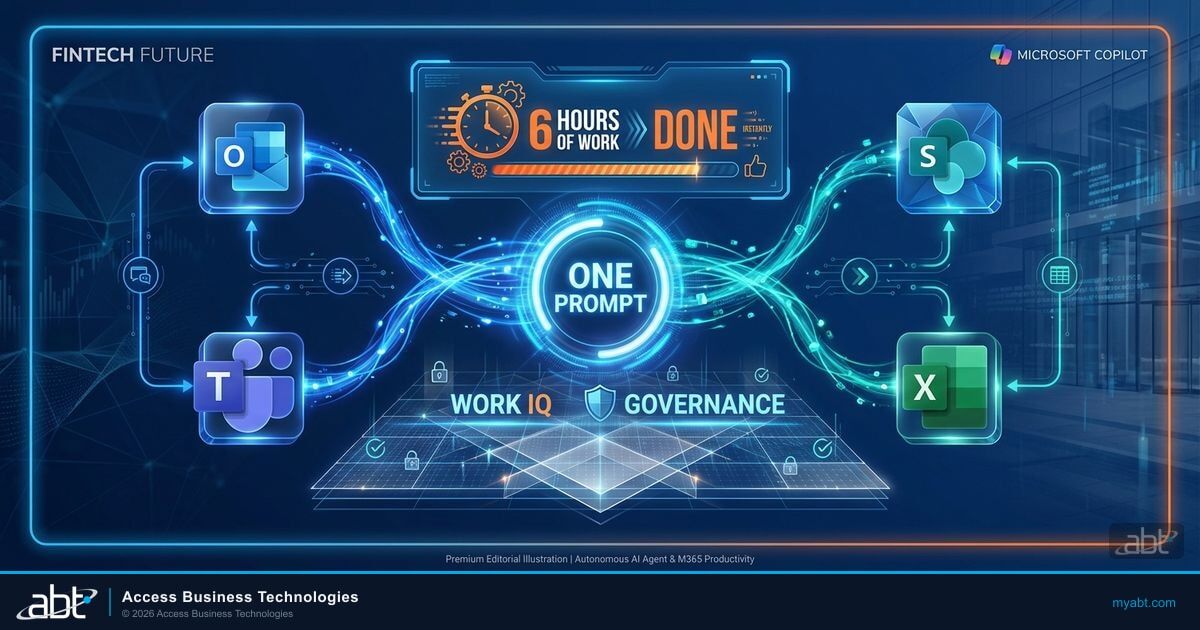
CoWork is the most significant expansion of Copilot since its original launch. Instead of answering one question at a time, CoWork handles multi-step tasks that unfold over hours: preparing a customer meeting by assembling a presentation, pulling financials from Excel, drafting the team email, and scheduling prep time. All from a single natural-language request. For financial institutions already using Copilot with proper security controls, this is the next phase of AI-driven productivity.
But CoWork also introduces new governance questions. It runs on Anthropic's Claude, the Opus 4.8 and Sonnet 4.6 models, alongside OpenAI's GPT, and it pauses for your approval before any sensitive action like sending an email or posting in Teams. Anthropic is a Microsoft subprocessor that has been on by default in most commercial tenants since January 2026, off by default in the European Union, EFTA, and the United Kingdom, and unavailable in government clouds, so whether Claude processes your data is a deliberate decision your compliance team owns, not a surprise. Here's what your institution gets, what it costs, and what your governance team needs to address before enabling it.
What CoWork Actually Does
CoWork takes a desired outcome described in natural language and breaks it into an execution plan with discrete steps. It reasons across Outlook, Teams, Excel, Word, PowerPoint, and SharePoint to carry work forward. You can see visible progress at each step and steer the work if it drifts.
CoWork (Multi-Step Agent)
Handles long-running tasks across multiple M365 apps
Creates an execution plan you can review and steer
13 built-in skills plus custom skills via OneDrive
Runs on Anthropic's Claude (Opus 4.8 and Sonnet 4.6) with GPT-5.5 for Frontier customers
Admin model picker routes routine tasks to lower-cost models
Standard Copilot (Single-Turn)
Answers one question at a time within a single app
Generates content on demand with no persistent plan
Built-in capabilities only, no custom skill extensions
Fixed model selection, no admin model picker
No per-task, usage-based cost controls
Microsoft demonstrated workflows like monthly budget reviews, competitive analysis with executive summaries and Excel workbooks, and full product launch plans that combine research, presentations, and outreach. Capital Group, one of the early testers, described it as "taking real action, connecting steps, coordinating tasks, and following through across everyday workflows."
The Multi-Model Architecture
CoWork runs more than one company's AI within the same workflow. At general availability, Microsoft confirmed CoWork runs on Anthropic's Claude, specifically the Opus 4.8 and Sonnet 4.6 models, with OpenAI's GPT-5.5 available to Frontier customers and a lower-cost Microsoft model, CoWork 1, on the way. Image generation uses Google's Imagen 2. An admin model picker lets your team route routine tasks to cheaper models and reserve the frontier engines for the work that needs them, which is also how you keep the usage-based bill in check.
Anthropic Sub-Processor: An Admin Decision, On by Default in Commercial Tenants
Anthropic is a listed sub-processor for Microsoft Online Services, and the toggle has been on by default for most commercial tenants since January 2026. EU, EFTA, and UK tenants have it off by default, and government clouds have no access at all. Your global admin controls this at the tenant level, so whether Claude processes data in your Microsoft 365 environment should be a deliberate vendor-management decision, not something nobody reviewed.
Pricing and Availability
CoWork is not bundled into your Copilot license, and that is the single most important thing for a finance team to understand. It reached worldwide general availability on June 16, 2026, and it is usage-based. Every user still needs a Microsoft 365 Copilot license, about thirty dollars per user per month, and on top of that CoWork bills by the task in Copilot Credits at one cent per credit, billed pay-as-you-go or through a discounted pre-commitment.
A CoWork task draws Copilot Credits based on the model it uses, the context it retrieves, the tools it calls, and how long it runs. A usage-based agent that works all day can cost real money, so the meter matters as much as the license.
For ABT's financial institution clients on Copilot Business plans, the base license still runs $21 to $32 per user per month through ABT's bundled pricing, with CoWork's usage charges layered on top. Microsoft publishes a Customer CoWork Estimator for modeling the bill, and heavy use across a team can run into the tens of thousands of dollars a month. Microsoft also gives admins a Cost Management Dashboard with per-user and per-group spend limits, including hard caps, so the bill cannot run away. One timing note: tenants that piloted CoWork in the Frontier program are not billed until July 1, 2026, while everyone enabling it fresh after general availability is billed from the moment it is switched on.
What Your Governance Team Must Lock Down
CoWork introduces three governance dimensions that standard Copilot doesn't: actions taken across your apps, data processed by more than one AI vendor, and workflows that run on a schedule over hours.
First, decide on the Anthropic sub-processor on purpose. It is on by default in commercial tenants and off by default in the EU, EFTA, and UK, so confirm its status matches your data classification policy rather than leaving it to chance. Second, remember that CoWork runs under the signed-in user's identity and reaches only what that user can already reach, which makes least-privilege access cleanup more urgent the moment an agent is doing the browsing. Third, wire CoWork's actions through Microsoft Purview: audit logging, sensitivity labels, and eDiscovery carry through what the agent does, and your compliance team needs those logs accessible for examiner requests.
Partner Intelligence: The Frontier Firm Advantage
IDC surveyed 4,000+ business and IT leaders and found that Frontier Firms, the top 22% leading AI adoption, report 88% top-line growth compared to 23% for laggards. Frontier Firms achieve a 2.84x return on AI spend while laggards get 0.84x, effectively losing money. 97% of Frontier Firms use generative AI in two or more business functions, averaging seven distinct functions compared to isolated deployment by laggards. The gap is widening, not closing.
Source: IDC Business Opportunity of AI Survey, August 2025 (4,000+ leaders, 16 countries)
Ready to Deploy CoWork with Governance Built In?
As the Tier-1 Microsoft Cloud Solution Provider that manages the Microsoft 365 tenants of more than 750 banks, credit unions, and mortgage companies, ABT turns CoWork on the right way: the readiness and least-privilege access so the agent only reaches what it should, Microsoft Purview governance and the audit trail your examiner expects, and the Copilot Credit spend caps that keep the bill predictable.
Frequently Asked Questions
CoWork reached worldwide general availability on June 16, 2026, after about three months in Microsoft's Frontier early-access program. It is not included free with a Copilot license. Every user needs a Microsoft 365 Copilot license, about thirty dollars per user per month, and CoWork then bills by the task in Copilot Credits at one cent per credit, pay-as-you-go or by discounted pre-commitment.
Yes. CoWork runs on Anthropic's Claude, the Opus 4.8 and Sonnet 4.6 models, alongside OpenAI's GPT. Anthropic is a Microsoft Online Services sub-processor that has been on by default for most commercial tenants since January 2026, off by default in the EU, EFTA, and UK, and unavailable in government clouds. Your global admin controls this at the tenant level, so confirm it matches your data classification policy.
Not for sensitive actions. Before CoWork sends an email, posts in Teams, or schedules a meeting, it stops and shows you a preview with a risk indicator and asks you to approve, edit, or cancel. It plans and carries out the routine steps on its own, but it does not take a sensitive action without your go-ahead, and Microsoft is explicit that it is not built for unreviewed high-stakes actions. Your governance framework should still define which workflow types require review at every step.
CoWork operates within Microsoft's Enterprise Data Protection framework, and its actions flow through Microsoft Purview: audit logging, sensitivity labels, eDiscovery, and Insider Risk all carry through what the agent does. For FFIEC-regulated institutions, the key additions are documenting your sub-processor review of Anthropic, tightening least-privilege access because CoWork runs under each user's permissions, and confirming Purview audit logs for agent actions are accessible for examiner review.
No, CoWork is not included free. It is usage-based and layered on top of a Microsoft 365 Copilot license, which runs about thirty dollars per user per month, or $21 to $32 through ABT's bundled SMB pricing. CoWork itself bills in Copilot Credits at one cent per credit, with pay-as-you-go or a discounted pre-commitment, and Microsoft gives admins a Cost Management Dashboard with per-user and per-group hard caps. Tenants that piloted CoWork in the Frontier program are not billed until July 1, 2026. Talk to your ABT licensing specialist to model the right path for your institution's size and usage.